Control, Dynamics & Estimation
Optimal Modified Feedback Strategies in LQ Games under Control Imperfections
Analyzed how execution errors in one player's feedback Nash strategy affect the other player's performance, and developed a disturbance-aware compensation law for finite-horizon LQ games.
Key Result In a simulated two-cart system, compensated feedback reduced Player 1's cost by 10.7% and integrated squared error by 41.3% relative to uncompensated feedback under the same actuator lag.
Overview
Feedback Nash equilibrium provides state-dependent strategies for interacting agents, but typically assumes that computed inputs are executed exactly. In practice, actuator dynamics can introduce deviations between intended and applied inputs. Because players interact through shared dynamics, one player's execution error can also affect the other player's cost.
This work characterizes that effect and develops a compensated feedback strategy that uses measurable execution deviations to mitigate the resulting performance loss.
Key results
10.7%
lower Player 1 cost
41.3%
lower Player 1 integrated squared error
Both relative to uncompensated reference feedback (REF) with the same Player 2 actuator lag, in a finite-horizon LQ two-cart spring–damper numerical example.
Problem formulation
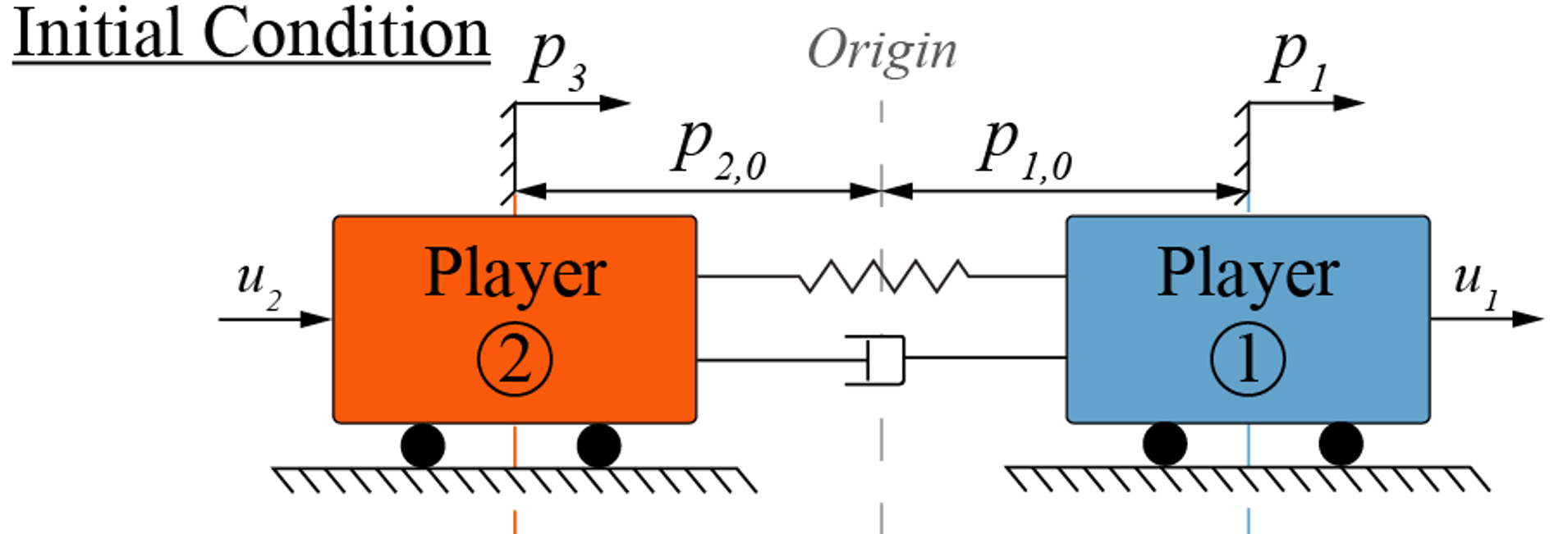
Two players interact over a finite horizon in a discrete-time linear–quadratic (LQ) dynamic game, each minimizing its own quadratic cost. Their feedback Nash policies are computed assuming nominal input execution.
Player 2's applied input, however, deviates from its nominal Nash command; in the benchmark, because of first-order actuator lag. The deviation propagates through the shared closed-loop dynamics, so Player 1's realized state trajectory and objective change as well, even though Player 1 executes its own policy exactly.
Contributions
-
Sensitivity analysis. Derived a first-order characterization of the effect of Player 2's execution deviations on the joint closed-loop state and Player 1's objective.
-
Deviation-aware compensation. Developed a causal compensated-feedback strategy that combines state feedback with a feedforward term based on measured execution deviations. The controller is obtained through an augmented finite-horizon LQ formulation using a Riccati recursion:
u1,k = −Kk xk − Lk wk
where xk is the joint state, wk is the measured execution deviation of Player 2, and the gains Kk, Lk come from the augmented Riccati recursion.
-
Theoretical analysis. Established that the compensated policy is optimal within the specified causal affine policy class, which contains the uncompensated reference feedback, and a local improvement guarantee: under the paper's assumptions, for sufficiently small deviations it performs no worse than the uncompensated feedback to second order.
Numerical evaluation
All three cases start from the same initial condition over the same horizon (N = 40 steps, ΔT = 0.015 s); Player 2's actuator lag has time constant τ = 0.8 s.
- FNE
- Both players execute their nominal feedback Nash policies exactly.
- REF
- Player 2 experiences actuator lag; Player 1 keeps its nominal feedback law.
- CF
- Player 2 experiences the same lag; Player 1 uses the compensated feedback.
| Metric | FNE | REF | CF |
|---|---|---|---|
| Player 1 cost | 325.31 | 492.40 | 439.67 |
| Player 1 integrated squared error | 0.1655 | 0.4566 | 0.2681 |
| Player 2 cost | 330.45 | 492.11 | 556.40 |
- Player 2's actuator lag raises Player 1's cost from 325.31 under FNE to 492.40 under REF.
- Compensated feedback reduces Player 1's cost from 492.40 to 439.67, a 10.7% reduction relative to REF, and Player 1's integrated squared error from 0.4566 to 0.2681, a 41.3% reduction.
- Measured against the FNE benchmark, compensation recovers about 31.6% of the additional Player 1 cost introduced by the lag.
- Player 2's cost increases under CF (556.40 vs. 492.11), so this is an improvement for the compensating player, not a Pareto improvement.
Skills