Minimum Lap Time Autonomous Racing Stack in AutoDrive Simulator
Developed reactive control and explored LiDAR, IMU, and wheel-encoder state estimation (EKF, SLAM, and an MLP estimator) for an autonomous racing stack in the AutoDRIVE simulator.
Key Result In simulation, the LiDAR-based reactive controller completed 10 consecutive collision-free laps on the Qualification Track; the team qualified in the AutoDRIVE RoboRacer Sim Racing qualification round.
- Reactive control (LiDAR): Designed and implemented a LiDAR-based reactive controller for track following, achieving 100% collision-free operation over 10 consecutive laps on the Qualification Track.
- Path planning (prototype): Prototyped a Delaunay Triangulation–based (DTR) raceline generation approach and shared findings with the teammate owning the final planning module.
- Tracking control: Tuned the path-tracking PID controller to improve stability and lap consistency. This stage was validated using an idealized localization source (IPS) as a baseline.
- Localization transition: Worked on replacing IPS with onboard state estimation to enable fully autonomous operation.
- Sensor fusion & state estimation: Explored multi-sensor localization by fusing LiDAR, IMU, and wheel encoders to estimate global position, yaw, and velocity.
- Estimation methods explored: Implemented and evaluated EKF, SLAM-based mapping/localization, and a learning-based (MLP) estimator.
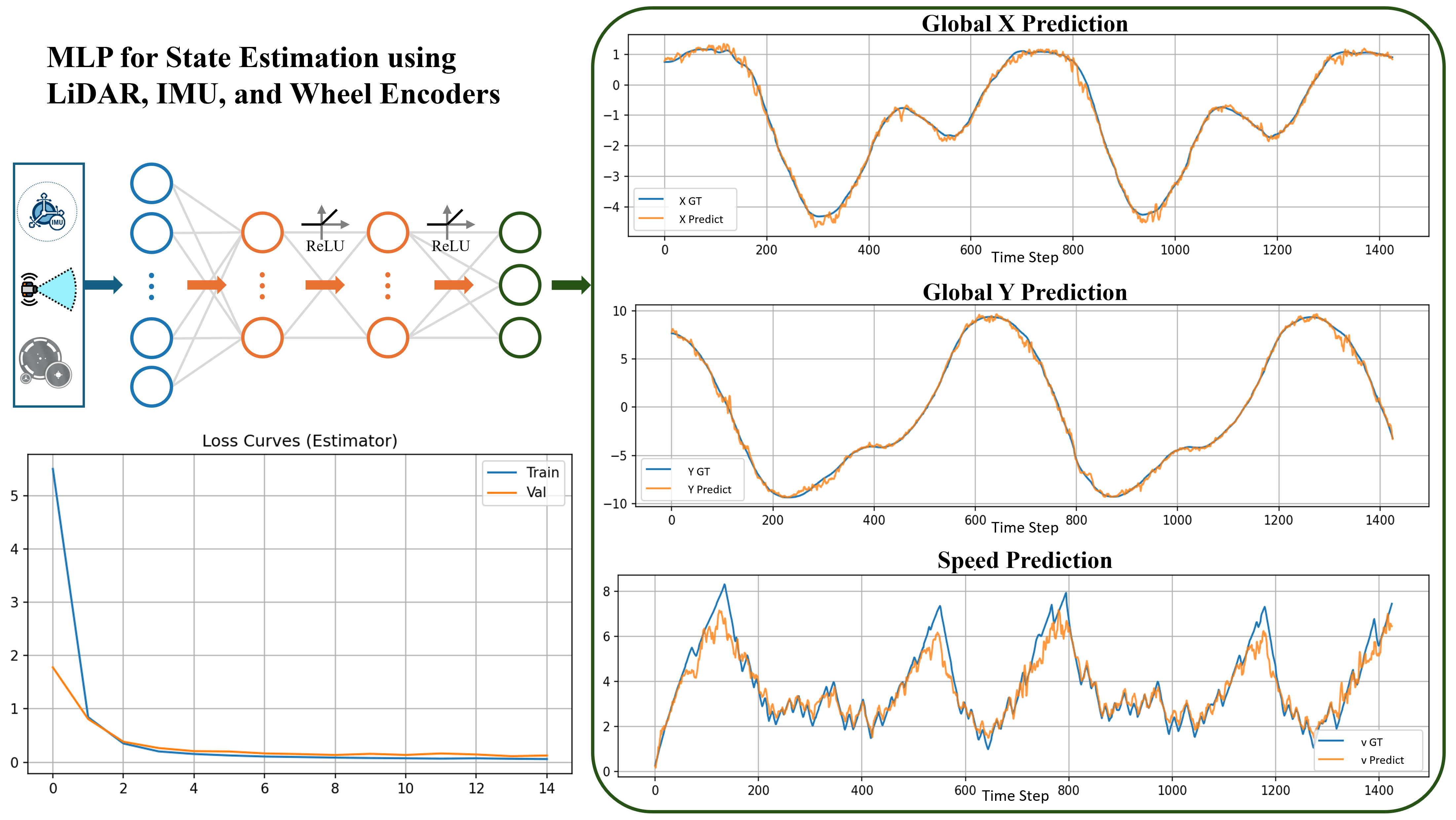
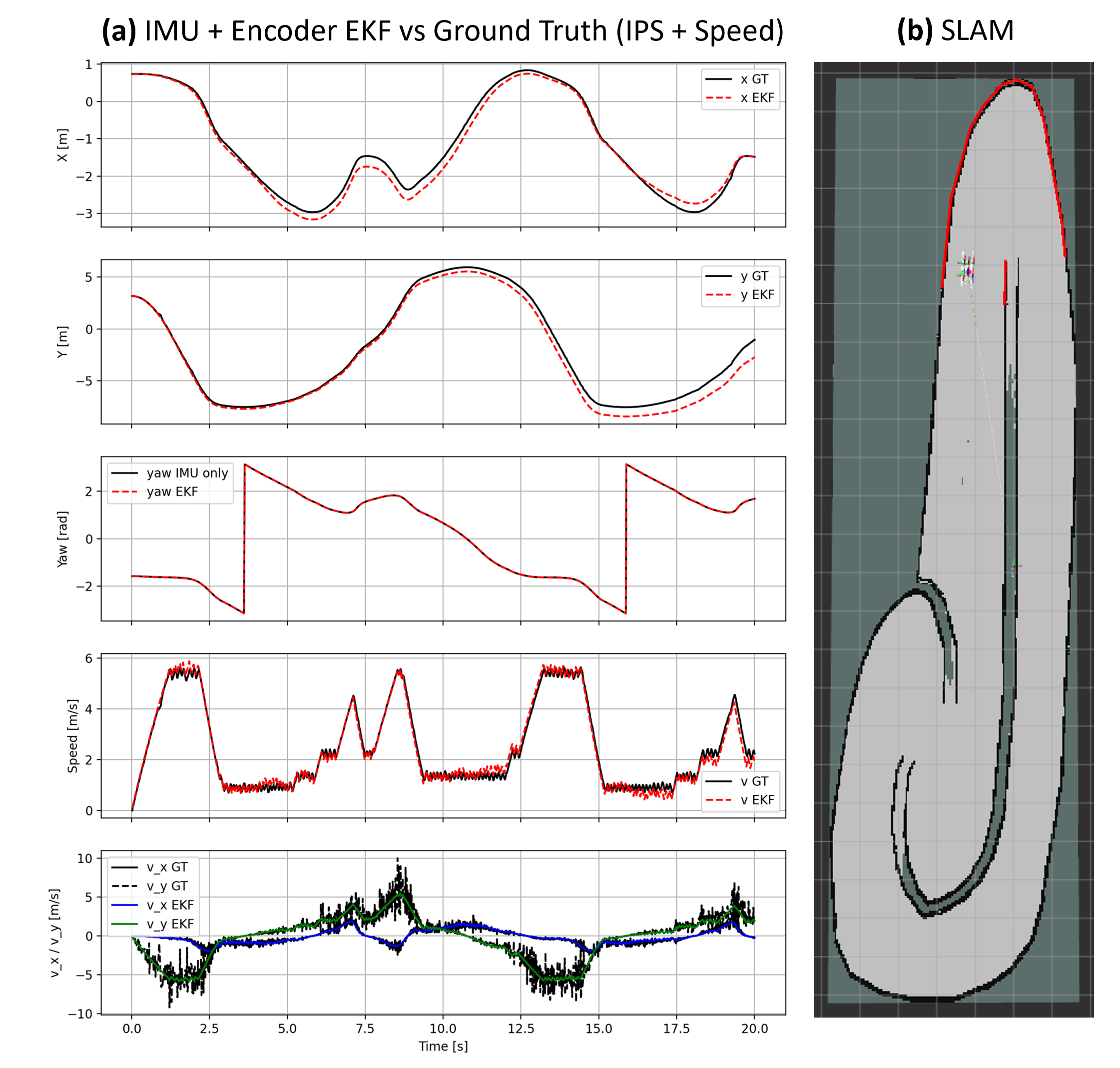
- Key insight: Achieved low estimation RMSE, yet observed large closed-loop tracking error, highlighting practical integration challenges between estimation quality and control performance (latency, tuning, and interfaces).
Artifacts: Docker Image
Skills
Note: Team qualified in the qualification round of AutoDRIVE RoboRacer Sim Racing (CDC-TF 2025).